

France Erupts as Thousands Protest Rising Costs, School Crisis; Police Arrest 135
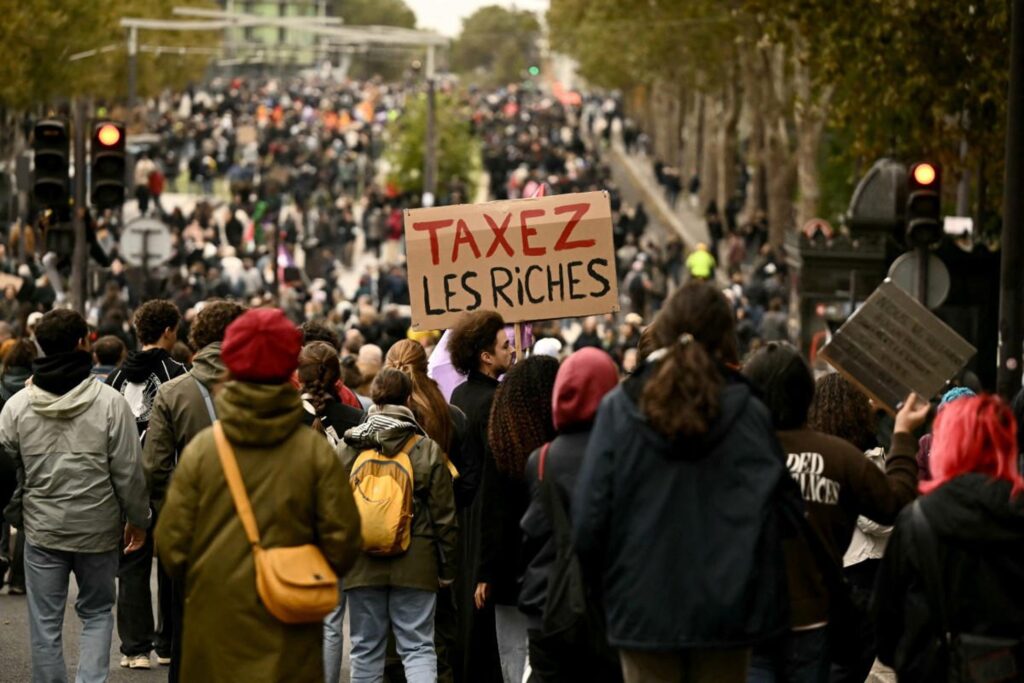
Tear gas fired as Macron faces mounting anger over inflation, school funding and police restrictions on protests; 70,000 security personnel deployed nationwide.
France was rocked by fresh protests on Saturday as thousands of students, workers and trade union members took to the streets over rising living costs, poor school conditions and demands for higher wages, piling pressure on President Emmanuel Macron.
Police fired tear gas in Lyon and used stun grenades in Clermont-Ferrand as demonstrations escalated in some areas, while authorities reported 135 arrests nationwide and seized weapons during security operations.
With memories of last weekend’s riots and looting still fresh, the French government deployed up to 70,000 security personnel across the country to prevent a repeat of the violence that damaged thousands of businesses and public buildings.
But despite the heavy security presence, public anger remained high, with protesters insisting they would not back down until the government addressed their demands.
From School Protest to National Uprising
What began last month as a protest over staff shortages at a high school southeast of Paris has grown into a nationwide movement, drawing students, workers and trade unions into a broader campaign against worsening living conditions.
Demonstrators are demanding more teachers, improved school facilities, higher wages, better pensions and stronger government support for students struggling with everyday expenses.
France’s National Institute of Statistics, INSEE, reported that energy prices rose by 21.3 per cent in September compared with the same period a year earlier, contributing to an overall inflation rate of 3.1 per cent.
Student groups are also demanding 250,000 additional places in higher education, an end to selection through the Parcoursup university admissions system, an extra €200 monthly in student grants and a rent freeze in public student housing.
Figures from the Education Ministry show that public middle and high schools lost 15.4 million teaching hours during the 2024–2025 school year because absent teachers were not replaced. That represented 7.5 per cent of scheduled teaching time.
Lagos Building Collapse Kills One, Leaves Three Workers Critically Injured
Macron Accused of Silencing Protesters
Tensions intensified after authorities restricted demonstrations in Paris, moving a planned march from the central Bastille area to Porte d’Italie on the southeastern edge of the capital.
Police warned people gathered at Bastille to leave or risk a €135 fine, while several rallies in other cities, including Lyon, Nice and Montpellier, faced bans.
Trade unions condemned the restrictions as an attack on freedom of expression, accusing the government of using last weekend’s violence as an excuse to limit peaceful demonstrations.
Union representative Murielle Guilbert described the restrictions as “scandalous,” arguing that protesters should be free to demonstrate where they choose.
A demonstrator identified as Zelie, 26, told the BBC that people had taken to the streets because of years of frustration and hardship under Macron’s government.
“We are in the streets because it’s been too long, it’s been too much,” she said.
Another protester said demonstrations would continue until the government responded to the people’s demands.
Businesses Shut, Museums Close as Security Tightens
The unrest has forced businesses across Paris to take precautionary measures, with shopkeepers boarding up storefronts amid fears of fresh looting and vandalism.
Major cultural institutions, including the Louvre, Orsay Museum, Picasso Museum and Grand Palais, were shut on Saturday.
Art Basel, a major contemporary art fair, also cancelled its weekend programme after opening to the public on Friday.
Last weekend’s unrest reportedly damaged or looted about 3,000 shops, while more than 2,700 people were arrested, according to reports on the previous round of demonstrations.
Interior Minister Laurent Nuñez acknowledged earlier in the week that police had lost control in some cities during the violence. He offered to resign, but Macron rejected the offer.
On Saturday, Nuñez said 135 people had been arrested nationwide. Items seized included fireworks, slingshots, metal and lead projectiles, improvised weapons, a katana and airsoft weapons.
Paris police described the situation in the capital as calm around midday, although security remained tight.
Anti-Far-Right Protest Adds to Political Pressure
Beyond the cost-of-living crisis, thousands also marched in Orléans against the far right as Marine Le Pen’s National Rally party held a two-day congress in the city.
Demonstrators raised anti-fascist slogans, highlighting the wider political tensions confronting France as discontent over public services, economic hardship and government policies continues to spread.
The protests come at a difficult moment for Macron, whose popularity has reportedly fallen to its lowest level since he took office in 2017.
The French president met high school representatives on Friday and reportedly promised changes to university admissions. However, student groups said demonstrations would continue until concrete measures were announced.
Meanwhile, the Yellow Vests movement, which previously organised disruptive protests against Macron, has called for another round of demonstrations on October 31.
The group and other organisers are also urging rallies and sit-ins outside parliament and city halls, accusing the government of an authoritarian drift and calling for the protection of civil liberties.
For Macron, the growing movement presents another major test of his government’s ability to contain public anger while restoring confidence in France’s public services and economic direction.
About The Author